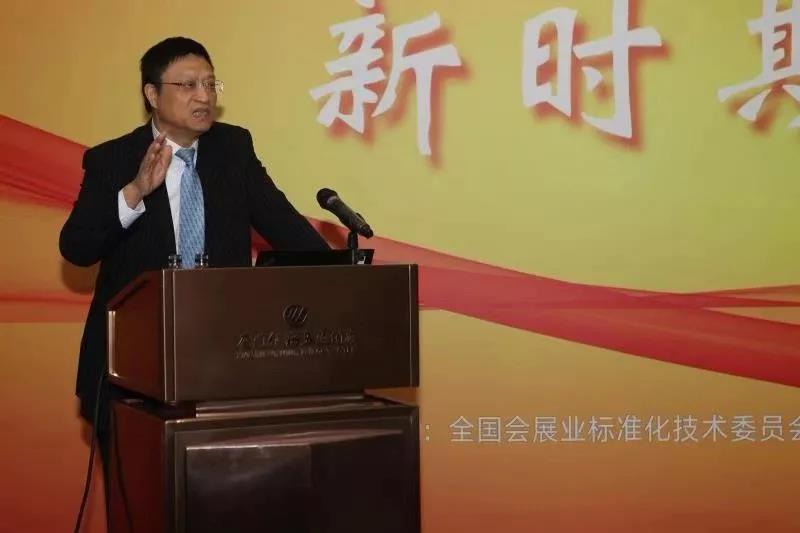
Economic Daily and China Economic Net reported from Beijing on November 29 that the 2018 annual meeting of the second National Technical Committee for Standardization of the Exhibition Industry, also the 2018 Exhibition Industry Standardization Annual Meeting, was held in Xiamen on the 25th under the theme New Era, New Opportunities, New Actions. Chen Xianjin, honorary president of UFI and chair of the National Technical Committee for Standardization of the Exhibition Industry, delivered a speech titled Working to Build a Standardization Complex for the Exhibition Industry in the New Era, discussing the path for such a complex.
Standardization is the leading benchmark for China's exhibition industry to move from large to strong.
Chen Xianjin pointed out that China's exhibition industry has completed its transformation from small to large and now faces the test of moving from large to strong. This test is reflected in several areas: construction of large and super-large venues continues one after another; competition among exhibition organizers is becoming increasingly intense; the exhibition industry chain is extending, expanding and being crossed by other sectors; expectations and results of industry-region integration need consideration; the relative roles of government and market need to be balanced; and the driving forces of going global and bringing in are changing.
Why build a standardization complex for the exhibition industry in the new era? Chen said standardization construction means forming institutional arrangements and using a complete standards system to improve the core competitiveness of exhibition enterprises as a whole, thereby accelerating transformation and upgrading of the exhibition industry. He answered the question from three levels.
First, standardization is the leading benchmark for China's exhibition industry to move from large to strong. The situation of being large but not strong, or large but not appropriate, must come to an end. The gap is not in scale but in quality. Quality improvement needs benchmarks, and benchmarks are standards. Standards turn the wishes and requirements of exhibition professionals from different cultural backgrounds into a common language and guide development from large to strong.
Second, standardization is an institutional arrangement for the transformation and upgrading of China's exhibition industry. Standards determine grades, and grades represent levels. Each standard represents the direction and requirements for the development of exhibition enterprises. Quantified standards should be used to identify every gap and locate weak points.
Third, standardization is technical support for structural adjustment in the exhibition industry. The larger the exhibition industry becomes, the more advanced its industrial structure will be, the finer and more specialized the social division of labor will become, and the more complex the links will be within the exhibition industry and between it and other industries. Standardization is technical support for industrial policy and a technical link for industrial structure. It influences structural adjustment in two ways: through industrial policy, and through integration with other factors in the industrial structure.
Exploring the path of a standardization complex for the exhibition industry in the new era
Chen discussed seven aspects of this path. First, standards are a pass for further opening the exhibition industry. Second, they are a catalyst for optimizing exhibition venue layout and improving service quality. The national standards Guidelines for Regional Exhibition Venue Planning and Guidelines for Functional Design of Exhibition Venues have been issued and implemented, providing guidance on venue planning, location selection, functional design, scale positioning and supporting facilities. The national standard Requirements for Exhibition Venue Service Management is under approval and addresses incomplete service content, unstable service quality and unclear use rules.
Third, standards act as traffic lights for green exhibitions and sustainable development. Green exhibitions currently face three prominent problems: environmental pollution, waste disposal and energy waste. Short-term solutions should begin with standards for construction materials and green exhibition booths. Government, associations, organizers, venues, design, engineering and material suppliers should work together, using industrial policy, financial policy, fiscal and tax incentives and other measures to build green exhibitions. In the long term, the industry should connect with international standard ISO 20121.
Fourth, standards are the dividing line for branded and professional exhibition projects. Brand building improves visibility and recognition, requiring scientific, objective and fair evaluation standards and grading systems for exhibition projects, so exhibitors and visitors can choose exhibitions based on evidence. Professionalization guarantees exhibition quality and requires corresponding service-process standards, strict regulation of service behavior and comprehensive improvement of exhibitor and professional visitor experience.
Fifth, standards are a connecting valve between government administrative reform and industry self-discipline. Government function transformation requires straightening out management systems, strengthening in-process and post-event supervision, and regulating government-run exhibitions. Industry self-regulation requires industry norms and standards to protect fair competition, maintain market order and promote healthy development. National standards on economic and trade exhibition data statistics and exhibition data audit rules have been released.
Sixth, standards are a protective embankment for the exhibition enterprise credit system. The credit system mainly includes credit information collection and processing, credit rating classification and evaluation methods, and credit disclosure norms. Its main participants include exhibition organizers and contractors, exhibition venues and exhibition service enterprises.
Seventh, standards are a balancer for integrated development of the exhibition industry. Standards should be used as a starting point to promote industry support and industrial linkage. The exhibition industry chain includes supporting services such as planning, design, logistics, construction, leasing, catering and on-site services, and related services such as transportation, communications, finance, tourism, advertising, printing and accommodation.
China has made important progress in building the exhibition standardization system.
Chen said important progress has been made in building China's exhibition standardization system. First, a national standards system for the exhibition industry has been established, with clear boundaries, complete levels, scientific structure and practical applicability. A near- and medium-term plan for national exhibition standards has been proposed. Second, national exhibition standards have been researched and drafted. Eleven centralized national standards have been issued and implemented, one is under approval, one is under research and four are in preliminary research. Third, national exhibition standards have been promoted and implemented through authoritative release conferences, lectures, seminars and other formats to support practical application and industry development. Fourth, standardization supports the overall industry strategy. The Standardization Administration and the Ministry of Commerce jointly issued guidance on strengthening exhibition industry standardization, clarifying the development strategy of standardization plus the exhibition industry. Fifth, international exhibition standardization is being actively advanced. China has participated in drafting ISO exhibition terminology standards and promoted a proposal for establishing a new ISO work area for the exhibition industry.
Chen said future work will focus on three areas. First, standardization should support exhibition industry reform. The guidance issued by the Standardization Administration and the Ministry of Commerce identifies five key directions: internet plus the exhibition industry, integrated development of the industry chain, resource allocation and operation, brand and credit system building, and industry management support. Second, diversified standards supply channels should be developed. Effective standards supply should be increased through the formulation and implementation of key national standards, support for group standards, and encouragement of enterprise standards and standards systems. Standards at different levels should have clear positioning: higher-level standards regulate basic industry rules, while lower-level standards regulate specific details. Third, international standardization should be strongly promoted by advancing an international-level mechanism for drafting exhibition standards and promoting bilateral mutual recognition of national standards.