
Source: Jibo
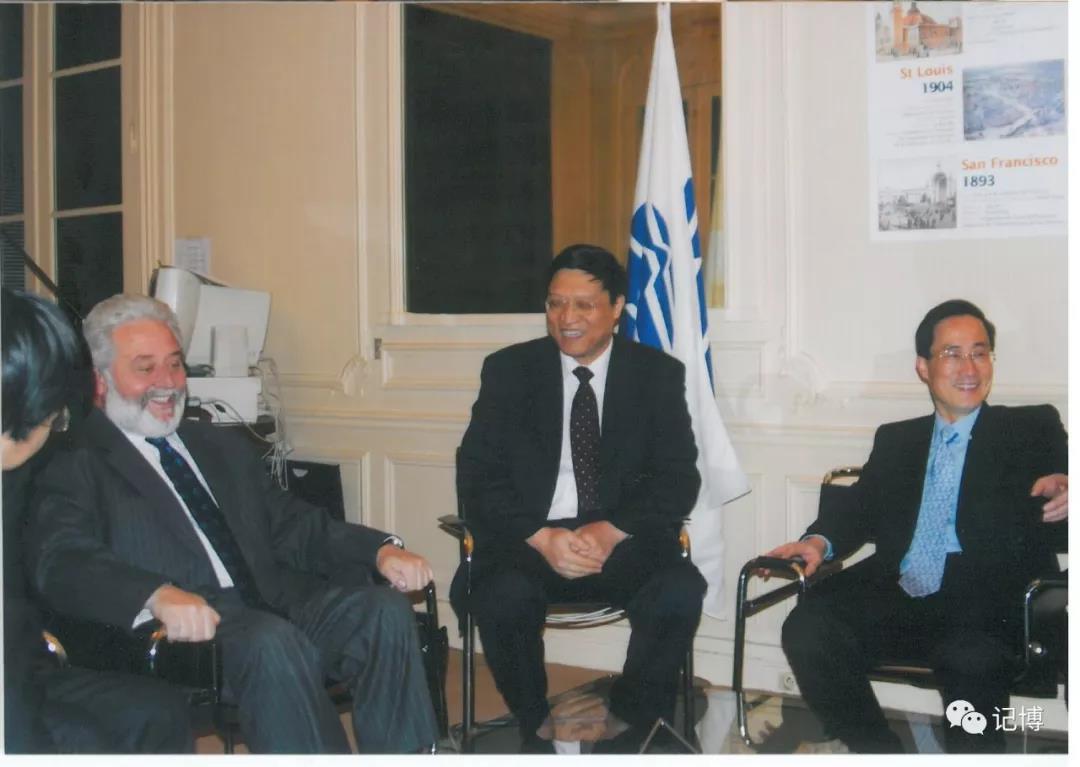
The author, center, meeting Vicente Gonzalez Loscertales, secretary general of the Bureau International des Expositions, while serving as deputy director of the Bureau of Shanghai World Expo Coordination.
The Growth of Shanghai's Exhibition Industry Has Been My Lifelong Pursuit
Chen Xianjin
October 2016
Encountering exhibitions
I was a junior middle school student of the so-called old three classes. I joined the army in 1969 and returned to Shanghai in 1974. I was assigned to work as an ordinary worker at the Foreign Trade Machinery Repair Factory under the Shanghai Foreign Trade Bureau. Because I had served as a regiment Youth League committee member in the army and this was recorded in my file, the factory Party secretary and director asked me to serve as a member of the factory Party branch committee and concurrently as secretary of the factory Youth League branch.
More than a year later, around the end of 1975, the Youth League committee of the Foreign Trade Bureau came to the factory for research. I reported on my work and talked about some grassroots Youth League branch work. Soon afterward, due to work needs, I was transferred to the bureau Youth League committee as a full-time cadre.
In 1977, China restored the national college entrance examination. After 1979, I gradually developed the idea of studying. I took the exam in July 1980 and entered the Foreign Trade Staff University in September. My mathematics score in the entrance exam was poor. After repeated discussion, the school leaders agreed to let me study on probation, with one requirement: if I failed advanced mathematics, my qualification to study would be cancelled. After entering school, I discovered that elementary mathematics, including geometry and trigonometric functions, was completely different from advanced mathematics, and without a foundation I could not keep up. I had to fight on two fronts. On one hand, I made up elementary mathematics intensively, memorizing formulas almost obsessively. From my home in Changning District to the university in Wujiaochang, I silently recited math formulas on the bus every day. On the other hand, I bought exercise books for advanced mathematics and worked through the problems one by one honestly, sleeping only three to four hours a day. As the saying goes, Heaven rewards diligence. After one semester, I scored 67 in advanced mathematics, 92 in the second semester, and a full score in the third. I believe that every effort brings a harvest, though sometimes several efforts may bring only one harvest. But without effort, there is certainly no harvest.
After graduating in July 1983, I very much wanted to do business work. At that time, the Shanghai Foreign Trade Bureau and the Shanghai Sub-Council of the China Council for the Promotion of International Trade, or CCPIT Shanghai, operated from the same office with two names and one team. Driven by China's opening-up policy, CCPIT Shanghai, which carried out foreign economic and trade exchanges in the name of a non-governmental organization, stood at the front line of reform and opening up. Its business fields continued to expand and its work content became increasingly rich. To meet the needs of the changing situation, it separated offices from the Shanghai Foreign Trade Bureau. I encountered this opportunity and came to CCPIT Shanghai, where I was assigned to the Exhibition Department, one of the core business departments at that time.
At that time, I had no feeling for exhibitions. To clarify the concept, I even consulted an industry classification manual to find a source. Shanghai's commercial sector was then divided into two broad categories, with Commerce Bureau One and Commerce Bureau Two. Commerce Bureau Two was mainly responsible for life services. I saw the word exhibition in this category. It was actually grouped together with cooked-water shops, also called tiger stoves, which supplied residents with boiling water, and public bathhouses. This shows how exhibitions were understood and what their social status was at that time.
After entering exhibition business, I first worked on trade liaison. Whenever an exhibition was held, the foreign exchange administration, quality supervision bureau, import and export inspection and quarantine bureau, customs, and other departments would work on site. If a Chinese enterprise became interested in certain equipment or goods, it needed layers of approval, inclusion in a plan, an application for a foreign exchange quota, negotiations by a foreign trade company, and finally import procedures handled by customs and others. Our trade liaison work was to help them open up each link step by step. In this way, I gradually became familiar with exhibition business and developed a certain attachment to it.
In September 1984, after study by the Party group of CCPIT Shanghai, I had the opportunity to attend a two-year senior manager training program and study in the United States. This was a China-US cooperation project negotiated by former mayor Wang Daohan and the mayor of San Francisco. In the first year, I studied at Shanghai Institute of Foreign Trade. One year later, American teachers gave courses and we undertook internships in the United States. I am very grateful that the organization gave me this opportunity. It not only improved my foreign language ability, but also helped me understand the basics of business management and learn advanced corporate management knowledge.
During our time in the United States, although we had classroom teaching, more of our time was spent in internships, with a focus on consulting and evaluation for projects. For example, if someone wanted to invest in a hotel or open a supermarket, we would investigate traffic in the relevant area, the consumption level of nearby residents, parking, housing, schools, and other factors, then submit a report stating how much investment was needed and how many years it would take to recover costs. The client could use this report to obtain a bank loan. In this way, I began to understand feasibility analysis, which was of great help to later exhibition project research, development, and decision-making.
Entering the enterprise
In 1984, CCPIT Shanghai established International Exhibition Company, with three departments: development, project, and trade liaison. I was already responsible for the Trade Liaison Department. After returning from study in the United States, I first served as manager of the department, responsible for the retained purchase business of exhibits after each exhibition, and later became deputy general manager of the company.
In 1990, CCPIT Shanghai restored the Exhibition Department, and I served as deputy secretary-general of CCPIT Shanghai and director of the Exhibition Department. At that time, CCPIT Shanghai had many overseas exhibitions, around three hundred each year. Whenever there was an exhibition, many businesses registered. We were responsible for contacting clients and assisting in organizing participation, including booking venues, arranging transport, building booths, and holding recommendation meetings. We also helped book air tickets and accommodation, doing both project organization and business travel work.
In 1992, Shanghai wanted to develop the Hongqiao Economic and Technological Development Zone and determined several major measures, including construction of the Shanghai International Exhibition Center, relocation of government agencies such as the Foreign Economic Relations and Trade Commission, construction of hotels such as the Yangtze River Hotel, and development of a foreign consulate area. Construction of the Shanghai International Exhibition Center was handled by Hongqiao Development Company. Its general manager, Kong Qingzhong, had a clear idea. He said that they understood venue construction but not management, and hoped CCPIT Shanghai could send someone to manage it. With leadership approval, I concurrently served as general manager of the company and gave it the English abbreviation INTEX. Before that, I had worked on inbound exhibitions, then outbound exhibitions, and now I began venue operation.
After becoming general manager of INTEX, I began to consider whether foreign capital and management experience could be introduced to quickly improve the management level of domestic exhibition venues.
P&O was a long-established British shipping company and one of the Fortune Global 500 enterprises at the time. It had invested in an exhibition venue in London, so it understood exhibition business and venue management. At that time, P&O hoped to internationalize its business and find an exhibition venue in Shanghai for a Chinese-foreign joint venture or cooperation. On behalf of CCPIT Shanghai, I negotiated together with the leaders of Hongqiao Development Company. In 1995, the negotiation finally succeeded.
When INTEX was built, because it was a key project, the venue investment was RMB 43 million. In negotiations with P&O, we proposed a valuation of RMB 120 million for the venue. P&O would hold 30 percent, CCPIT Shanghai 30 percent, and Hongqiao Development Company 40 percent. This was a win-win-win result. The British side invested RMB 36 million and received profit distribution the following year. Through cooperation on this project, Hongqiao Development not only recovered its investment but also gained considerable profit. CCPIT Shanghai also obtained a certain shareholding through management output.
However, this result did not come easily. The British were very serious. At the beginning of the negotiation, they questioned the value of the venue. Because the project schedule was tight, they began pointing out defects. Later, I said to them that we should think differently. For example, if you go to buy apples and there is only one apple, which you like but which has some flaws, whether you want it or not, it is still the only apple. It is unrealistic to insist on finding a perfect apple. If you say this building has problems, we can repair and improve them. In the end, the British side accepted our suggestion, and the negotiation concluded smoothly. China's first Chinese-foreign cooperative exhibition venue emerged.
After 1997, I felt that the company could not rely only on renting out the venue. It also needed to organize its own exhibitions. We independently developed nearly ten self-organized exhibitions, including the music exhibition, flower exhibition, rail transit exhibition, lubricants exhibition, lighting and sound exhibition, and assistive products exhibition, which is now the rehabilitation exhibition. The selection, development, and growth of these exhibitions all involved a difficult process, but they are unforgettable. These exhibitions have now become the company's main business and revenue source.
Facing the whole country
In the late 1990s, Shanghai International Exhibition Center began preparing Expo Central China, and my vision began to move from Shanghai to the whole country.
There were two reasons for holding Expo Central China. First, while working at INTEX, we planned some self-organized exhibitions. Because of these exhibitions, our company had contact with exhibition organizers across the country and understood the national situation. We felt that the exhibition industry had just begun to develop, levels varied widely by region, and communication within the industry was urgently needed. Second, I attended some events in the United States and saw the situation abroad. Their exhibition organization level inspired me. IAEE had an event called TS2, which included both an exhibition and a conference. It exhibited display design and exhibition materials, and visitors were staff from the exhibition departments of major companies who exchanged ideas on how to participate in exhibitions. At that time, the Ministry of Foreign Trade and Economic Cooperation held a meeting in Nanjing for foreign trade and economic cooperation departments from provinces, municipalities, and autonomous regions nationwide. I introduced this situation there, and the response was very strong.
Thus, by comparing China's exhibition organization level and combining what we learned abroad, we began trying to hold exhibition-related shows and conferences. The exhibition was similar to TS2 in the United States, namely an exhibition within the exhibition industry, while the conference focused on industry exchange and mutual learning.
After extensive communication, it was decided that INTEX and China International Exhibition Center Group would cooperate to prepare Expo Central China. In February 1999, I went abroad to attract exhibitors. In January 2000, our first Expo Central China opened at the International Convention Center in Pudong, and all 900 seats were filled. After the opening ceremony, we rented 15 buses and took everyone to INTEX to see the exhibition. Several forum sub-venues were packed, and exhibition industry professionals from around the country were very enthusiastic. Some without seats sat on the floor to listen.
The second session was held in Beijing in January 2001, the third in Guangzhou in January 2002, and the fourth in Wuhan in January 2003. When we held the fifth Expo Central China in January 2004, the Exhibition Department of CCPIT and CIEC approached me and proposed that CCPIT take over. From the overall perspective of the national exhibition industry, we agreed. After that, the forum of Expo Central China was renamed the China Expo Forum for International Cooperation, or CEFCO. The first CEFCO was held in 2005, and the thirteenth was held in Macau in 2017. Unfortunately, the exhibition section of Expo Central China was not maintained and has now stopped.
Through these activities, I gradually became familiar with exhibition professionals across the country and understood national industry development. The so-called three Chens of China's exhibition circle - Chen Ruowei in Beijing, then deputy general manager of CIEC; Chen Barong in Guangzhou, then deputy general manager of China Foreign Trade Centre Group and now deceased; and Chen Xianjin in Shanghai - were named and circulated by the media during those sessions of Expo Central China.
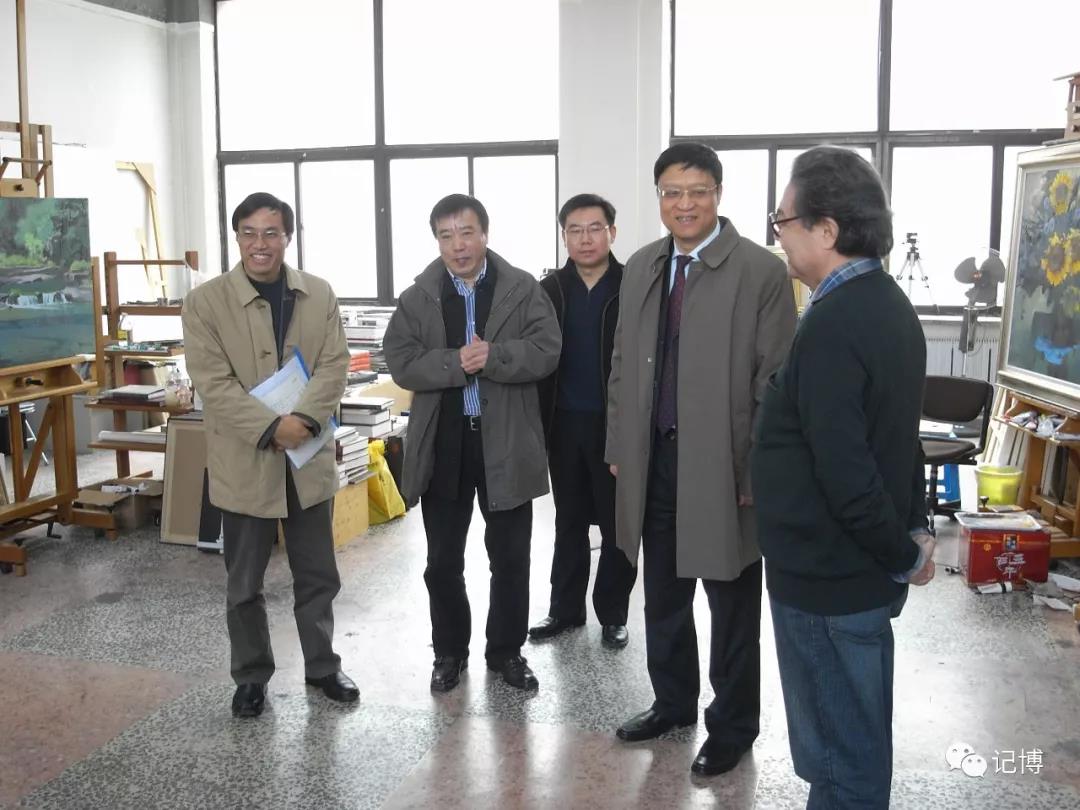
The author, second from right, checking the work of the China National Pavilion design team for the Shanghai World Expo.
Participating in the World Expo
The Shanghai World Expo was the largest exhibition event China had held to date, and I was fortunate to be involved in the project from the bidding stage. In September 2001, the Shanghai World Expo Bid Office was organizing the preparation of the bid report. I was then vice president of CCPIT Shanghai and was invited, as an exhibition expert, to participate for the first time in a seminar on the bid report organized by the Bid Office.
After that meeting, Shanghai began preparations to receive the inspection delegation of the Bureau International des Expositions, and I was identified as one of the presenters. In March 2002, at the report meeting for the BIE inspection delegation, I gave a presentation on the commercial operation of the Shanghai World Expo. I introduced the operating entity, financial structure, market development ideas, and other aspects of the Shanghai World Expo, all of which were of great concern to the BIE inspection delegation. After my presentation, the delegation asked many questions about the scope of use for marketing and publicity expenses, assistance to less developed countries, the possible competition for human resources between the Shanghai World Expo and the Beijing Olympic Games, balancing the principle of low ticket prices with revenue and expenditure balance, and the hierarchical structure of sponsors. I answered them all on the spot.
After this inspection, in order to strengthen the World Expo bid work, I was transferred to the Shanghai World Expo Bid Office and served as full-time deputy director. From then on, I began a ten-year World Expo career.
After joining the Bid Office, I was first responsible for organizing the corporate support group. At the end of July 2002, the State Council established a comprehensive working group, and I was the Shanghai lead, taking several colleagues to be stationed in Beijing and focusing on coordination work before the vote.
After the bid succeeded, I first participated in the director's office mechanism of the Shanghai World Expo Bureau as president of the World Expo Group, and later served as deputy director of the World Expo Bureau. In that position, I was responsible for investment promotion and ticketing. I joked with friends that I was both the head of the world's largest beggar gang, because through market development we raised more than RMB 6 billion, and the world's largest ticket seller, because the ticketing department I led sold more than 70 million tickets and also raised more than RMB 6 billion. In addition to these two tasks, I also undertook the organization of exhibition planning for the China National Pavilion and the five Theme Pavilions, including organizing exhibitions by provinces and municipalities. Each of these six pavilions had an exhibition area of more than 10,000 square meters, and because they represented China's image, the pressure was great. Relying on several well-known Chinese cultural creativity and exhibition planning institutions, we repeatedly discussed specific exhibition items, including films, and submitted multiple rounds of plans level by level until reporting to central leaders and forming the final exhibition plan. What was especially gratifying was that the China National Pavilion achieved three satisfactions in its display effect: satisfaction from visitors, media, and national leaders.
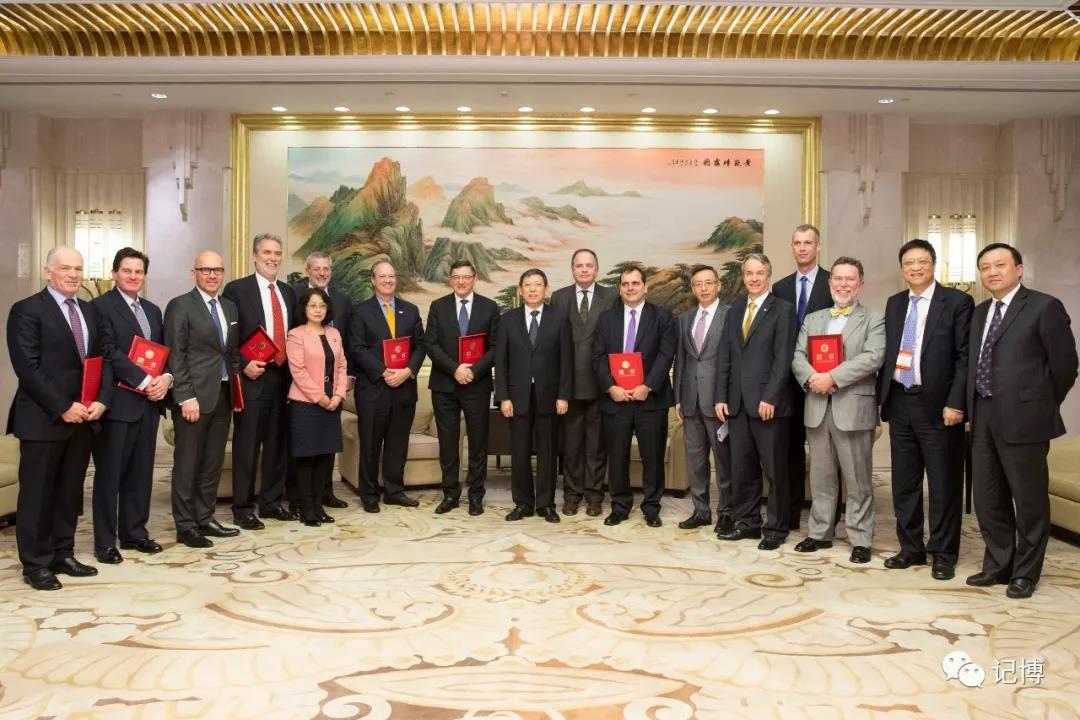
The author, second from right, accompanying Mayor Yang Xiong to meet international advisers to Shanghai's exhibition industry.
Going international
In early 2011, shortly after the Shanghai World Expo ended, I attended the CEFCO meeting in Hangzhou. At that time, I was already Asia-Pacific chairman of UFI, the Global Association of the Exhibition Industry.
Shanghai International Exhibition Co., Ltd. was among the earliest exhibition enterprises in Shanghai to join UFI. Our auto show, mold exhibition, and other events were UFI-approved projects. From 2007, I served as UFI Asia-Pacific chairman and also as a member of the UFI Executive Committee, with each term lasting three years; I served two terms. During the Shanghai World Expo, I invited staff from UFI headquarters to visit the Expo, leaving UFI with a deep impression. In 2011, the UFI presidential trio contacted me and expressed interest in asking me to serve as UFI president. I thanked them for their kindness, but said I could not decide and needed to ask the organization for instructions.
At that time, I was deputy director of the Shanghai World Expo Bureau. After I reported to the main bureau leaders, they attached great importance to the matter and specifically asked municipal leaders for instructions. After research by the Organization Department of the Shanghai Municipal Party Committee and the Shanghai Foreign Affairs Office, and after seeking instructions from relevant national departments, all agreed that this was a good thing and should be supported. I therefore completed the domestic procedures. Later, after discussion by the UFI Executive Committee and election by the board, I served as UFI president-elect in 2012, president in 2013, outgoing president in 2014, and then honorary president for life.
During my three years as UFI president, my main work was, first, to help domestic enterprises go international and obtain UFI certification. China is now the country with the largest number of UFI members. Second, I introduced China's exhibition situation to the international exhibition community. Third, I safeguarded the status and reputation of China's exhibition industry.
For example, several important UFI members cooperated on a G-Guide safety standard and recommended it to UFI. The text of this document had no major problems, but its background was directed at emerging developing countries. At a UFI Executive Committee meeting, I said that the starting point of this standard was good and the principles were acceptable, but it clearly stated that exhibitions in developing countries had safety problems, which was not realistic and was at least incomplete. In China, for instance, the largest venues are invested in by Germans, and many projects are also carried out jointly by Chinese-foreign joint ventures. Do you yourselves feel very unsafe? I also said that China has strict safety regulations for exhibitions and other major events, and the government attaches great importance to safety. I hoped they would conduct deeper research before forming complete and objective opinions. After my remarks, the vast majority of executive committee members agreed with my view, and later this safety standard was further revised before being recommended to UFI members.
In exchanges with the international exhibition industry, I also did one thing: transforming competition around the Shanghai International Automobile Industry Exhibition from a zero-sum game to a positive-sum game.
In 2002, I was chairman of Shanghai International Exhibition Co., Ltd., and our company was responsible for organizing the biennial Shanghai International Automobile Industry Exhibition. Before then, Shanghai had not yet built a large exhibition venue. The 2001 auto show could only be held across three districts and four venues: Shanghai Exhibition Center in Jing'an District, Everbright Convention and Exhibition Center in Xuhui District, Shanghai International Exhibition Center in Changning District, and ShanghaiMart. This naturally affected the visitor experience and exhibitors' promotion. It was not until November of that year that Shanghai New International Expo Centre, jointly funded by Shanghai Lujiazui Group and three well-known German exhibition companies, opened. With a total exhibition area of more than 100,000 square meters, it was the most modern venue at the time and became a savior for some major exhibitions. Yet conflicts also arose from this.
The auto show organized by our company already had many years of history, and everyone hoped to move it to Shanghai New International Expo Centre in 2003 to resolve the bottleneck in hardware facilities. At that time, a well-known international exhibition company also announced that it would hold an auto show in 2003. Two auto shows held at the same time would clearly benefit no one, because the exhibitors were the same. Under coordination by the municipal government, both sides decided to cooperate. My thinking at that time was to integrate the superior resources of the Chinese and foreign exhibition companies through cooperation, build an influential international brand with a voice, and enhance the international status of Shanghai's exhibition industry. Unfortunately, the other side proposed a disruptive plan and left no room, causing the cooperation negotiations to reach a deadlock.
What should we do in that situation? I felt that if one side's gains in competition necessarily meant the other side's losses, then gains and losses would add up only to zero. That was a zero-sum game, and it clearly could not achieve the goal of building a world-famous brand exhibition. So we planned carefully and found another path. First, we invited organizations with direct influence on the Shanghai auto show and the development of China's automobile industry to participate in the show and take the stage, such as national industry organizations including the China Association of Automobile Manufacturers and the Society of Automotive Engineers of China. At the same time, we introduced an auto parts exhibition organized by another internationally known exhibition company into the framework of the Shanghai auto show. This both enriched the show's content and expanded its scale, while also securing the venue schedule. In this way, through horizontal alliances and vertical integration, the Shanghai auto show found a path from zero-sum to positive-sum competition and achieved a win-win effect for multiple parties.
That unforgettable competition happened more than ten years ago. Today, the Shanghai auto show has become one of the most famous Class A auto shows internationally, as well as a brand of Shanghai's exhibition industry and a calling card of the city. I deeply understand that competition is objective, and we also welcome competition. But the guiding idea must be clear: Shanghai should be built into a world-famous exhibition center city. Therefore, as long as something helps make independent brand exhibitions larger and stronger, I will spare no effort to fight for it and work for it.
A new position
In 2014, because Wu Chenglin, founder and first president of the Shanghai Convention and Exhibition Industries Association, was already over 70, and according to leadership requirements, I was transferred from the position of deputy director of the Shanghai Municipal Commission of Commerce to the Association, succeeding Wu Chenglin as the Association's second president.
In a certain sense, this was a new challenge for me. First, the situation of the exhibition industry was very different from before. In April 2015, the State Council issued the first national-level guiding document for the exhibition industry in history, while Shanghai's 13th Five-Year Plan beginning in 2016 proposed building the city into an international exhibition capital. These provided good development opportunities and higher requirements for Shanghai exhibition enterprises. Compared with other parts of the country, Shanghai's exhibition industry has a relatively high degree of internationalization, marketization, and specialization, but compared with the requirements of an international exhibition capital, there is still a long way to go. In fact, Shanghai's exhibition industry still has many problems to solve. Second, with the continuous improvement of the market economy system and the reform of government management functions, government guidance for industry development is increasingly implemented through intermediary organizations. How industry associations should operate, and how the staff of industry associations can become professionalized, still require innovation and breakthroughs.
As president, my greatest wish is to see Shanghai's exhibition industry play a greater role in Shanghai's social and economic development, and to see the Shanghai Convention and Exhibition Industries Association provide more effective services to its members. I clearly understand that although Shanghai's exhibition industry has a good foundation and good conditions, it is still far from the five standards for an international exhibition center city proposed by UFI. The most important gap is not hardware, but software, especially the establishment of fair, open, transparent, and accessible market rules. As president of the industry association, I am willing to think and act together with colleagues across Shanghai's exhibition community, strengthen industry self-discipline, formulate rules of the game, improve integrity and exhibition quality, and make Shanghai's exhibition industry truly become an important platform for a modern market system and an open economic system.