

Presentation Topic: New Developments in the Global Exhibition Industry
Presenter: Mr. He Tingkai, General Manager/CEO of the International Exhibitions Association
Key Points of the Presentation:
Exhibitions represent one of the oldest and most enduring commercial models, with a history spanning several millennia. It is a thriving industry. In November 2016, Mr. Chen Jianxin predicted that the global exhibition industry would grow faster than the global economy in 2017, which proved to be true. In 2017, the global economy grew by 3.5%, while the exhibition industry grew by more than 4%. This is the result of our hard work.

Regarding the Global Exhibition Market:
UFI conducts surveys of exhibition venues and organizers every two years to forecast the prospects for the next 6-12 months. According to the latest statistics, there are 1212 exhibition venues worldwide, with nearly 4.4 million companies participating in exhibitions each year, creating 68,000 jobs (excluding jobs in nearby hotels and other service industries). The total spending by visitors and exhibitors reached 98 billion euros.
Survey Results Related to China:
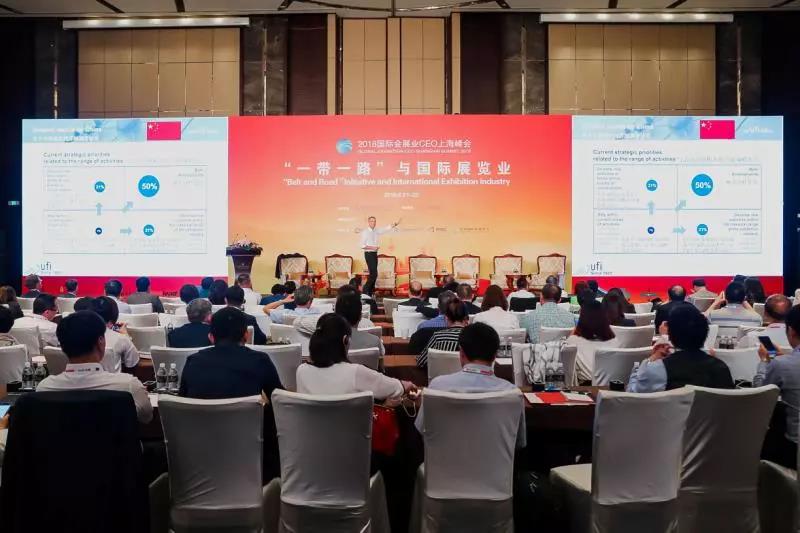
1, Market Development StrategyDoes the company prefer to maintain traditional project scopes, or develop new projects outside of traditional scopes? Or are both approaches pursued simultaneously?
Our survey covered markets in 18 countries. Notably, the Chinese market exhibited consistent dynamism: the percentage of projects developed concurrently reached approximately 50%. Organizers of venues and exhibitions generally expressed satisfaction with existing projects while also actively considering the development of new projects.
2. Project Regional StrategyDoes the company prefer to host events in China or in countries that have not previously hosted events?
57% of surveyed companies explicitly stated their desire to host events in countries that have not previously hosted events, indicating a further strengthening of China's international ambitions.
3. Share of Expected Revenue from New Business Models
36% of companies expect that 10-25% of their revenue will come from new business models in the next five years; 36% of companies expect that new business models will generate more than 25% of their revenue within ten years, which is a remarkable phenomenon.
4. Exhibition Area:
As of the end of December 2017, the top five countries with the largest indoor exhibition areas accounted for 60% of the global indoor exhibition area.
The United States ranked first, with 326 exhibition halls covering 6.85 million square meters, representing 20% of the global market.
China ranked second, with 110 exhibition halls covering 5.75 million square meters, representing 17% of the global market.
Germany ranked third, with 9% of the global market, followed by Italy and France.
Chinese exhibition areas have the fastest growth rate, with a 26.5% increase since 2011. Currently, there are 13 exhibition halls exceeding 100,000 square meters.
Good infrastructure requires filling with exhibition projects and sufficient management personnel.
Compared to stronger hardware infrastructure, China still lags in operational capabilities and related software support.
Regional surveys
Mergers and acquisitions remain a constant theme in the exhibition industry, with many well-known companies having already been merged or acquired. China is also beginning to adopt this practice, such as the Thailand International Dog Show, which represents a step for Chinese exhibition companies to go international and marks a new chapter.
JWC conducted a comparative analysis of organic growth and growth through mergers and acquisitions, highlighting the shift towards acquisitions as the primary driver of growth. While the current shift is not significant, increasing industry growth is expected to come from acquisitions.
Regarding digitalization and industry development
The application of digitalization in the exhibition industry has three levels:
First, the digitalization of the exhibition project itself, such as matching the project with digital tools or apps.Second, the digitalization of corporate operations, including internal processes, procurement processes, and travel processes, which have all been digitized. This level has become a standard practice for many companies.Third, the gradual development of online business through digital platforms, which has significant potential. Currently, the global exhibition industry is characterized by a diverse range of progress in different areas.
The global exhibition industry is currently characterized by a diverse range of progress in different areas.The United Kingdom is currently leading, followed by Germany and China, which is also highly advanced in digitalization.
Digital transformation aims to prioritize visitor experience in exhibitions, conferences, and festivals.—If you can effectively engage your audience, then you have achieved success.
The Chinese government is closely monitoring the preparations for the China International Import Expo, which is a key part of the reform process. I understand that the organizers are implementing many innovative digital solutions, which are worth following.

Regarding the application of blockchain in the exhibition industry.
Blockchain technology has long-term and profound impacts on the internet and global development, but it has not yet been widely adopted in the exhibition industry. Not all potentially successful technologies can be successfully applied to any industry; whether blockchain can be successfully applied to the exhibition industry remains to be seen.